
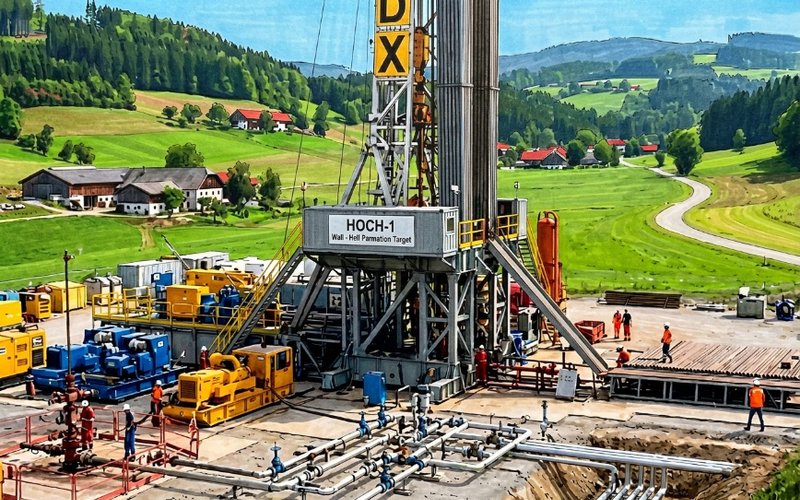

- 01HOCH-1 hits gas in Hall; MD ~1,350m.
- 02Biogenic, 100% methane; logs & tests needed.
- 033D seismic matches Hall; next wells GOLD-1, SCHOEN-1 for 2026.
ADX Energy (ASX: ADX) says its HOCH-1 shallow gas exploration well in Upper Austria has encountered gas-filled sands in the Miocene Hall formation, marking the first material subsurface read-through from its 2026 shallow gas drilling program.
The immediate investor takeaway is that the gas show supports the pre-drill geological model, but reservoir quality, net pay, and commercial deliverability still depend on wireline logging and later production testing.
The HOCH-1 well is a shallow gas exploration test targeting sandstone reservoirs in the Hall formation, where ADX is operator and holds a 50% economic interest.
ADX said HOCH-1 encountered gas-filled sands at about 1,350 metres measured depth, before detailed logging.
The well was still drilling ahead in a 6 1/8 inch hole at MD 1,367m, with the company expecting to deepen it to at least MD 1,550m because of additional gas shows.
Biogenic Gas Interpretation
The company described the gas interpretation as biogenic and 100% methane, based on drill cuttings, mud logs, compositional gas analysis and high total gas concentrations.
That gives more support than a simple show recorded while drilling, although it still falls short of proving reservoir performance.
One of the more important technical details in the release is ADX’s statement that the Hall reservoir intersections correlate “almost exactly” with pre-drill 3D seismic predictions.
In plain terms, the company is saying the well is finding the target where its subsurface model indicated it should be. That does not answer the commercial questions, but it does suggest the structural interpretation has held up so far.
How HOCH Fits the Program
HOCH-1 is the first well in ADX’s three-well shallow gas campaign in Upper Austria, where the company has previously identified the follow-up wells as GOLD-1 and SCHOEN-1, with both already permitted for drilling in 2026.
That broader program sits inside ADX’s Upper Austria Exploration and Appraisal segment, where management has emphasised shorter-cycle, near-infrastructure opportunities.
The company regards this portfolio as separate from its producing Austrian assets in the Vienna Basin Fields and Anshof Field, and from its offshore Italian permit held through Audax Energy S.r.l., the subsidiary that operates the 100%-owned C.R150.AU Sicily Channel exploration permit.
For HOCH-1, the attraction is the combination of shallow target depth and existing infrastructure.
Earlier filings said the well was originally planned to reach about 1,430m MD and sat roughly 2 kilometres from pipeline infrastructure, while ADX has also previously described the shallow gas concept as suitable for cluster development with nearby prospects, including SCHOEN.
Numbers and Next Work
ADX has previously disclosed mean prospective resources of 8.0 BCF and a high case of 17.3 BCF for the HOCH prospect.
The next technical milestone is wireline logging, scheduled for 7 May 2026.
ADX said the logging program is intended to confirm net reservoir thickness, reservoir quality, and gas saturation, with a quick-look analysis expected shortly afterwards.
If those results support the drilling observations, the company said the well is planned to be cased and completed in preparation for production testing.
That testing is the step intended to determine deliverability and reserves potential. It is also the point at which the market gets a more practical read on whether the encouraging gas show can translate into something more than a geological success.
What Matters From Here
The first thing to watch is whether wireline data confirms the initial read from drilling, with investors looking for evidence on reservoir thickness, porosity, and gas saturation, rather than just confirmation that methane is present.
After that, the key issue becomes flow performance, with production testing intended to determine deliverability and reserves potential.
That is particularly relevant because another part of the Austrian portfolio, Welchau-1, previously recovered hydrocarbons during testing but did not achieve stable-flow inflow.
In other words, hydrocarbon presence alone does not settle the commercial question.
Execution and regulatory timing also matter, with ADX recently forced to deal with mechanical downtime in its Austrian production base and earlier court-related interruptions to Welchau environmental clearances.
Those events do not directly affect the current HOCH-1 result, but they are a reminder that positive drilling data still sits within a broader chain of operational and approval steps.
Promising Hit, Still Early
Today’s announcement gives ADX a constructive early drilling result at HOCH-1, with gas-filled Hall formation sands encountered broadly where the seismic model suggested they should be.
The company’s Austria production assets remain the cash-generating base supporting this work.
Austrian production averaged about 248 BOEPD net in 2025, up from 211 BOEPD in 2024, while average net production was 200 BOEPD and sales revenue cash received reached A$2.1 million.
That operating base gives context for how the company is trying to fund exploration, even as it continues to rely on external capital and partner structures.
But the release stops short of proving commerciality: the next read-through comes from wireline logging, followed by any casing, completion and production testing decisions, while funding and execution risk remain part of the wider company story.
Get the wire before the market opens.
The ASX small-cap stories that matter, filed before 9am AEST. Curated by the Small Caps desk.