
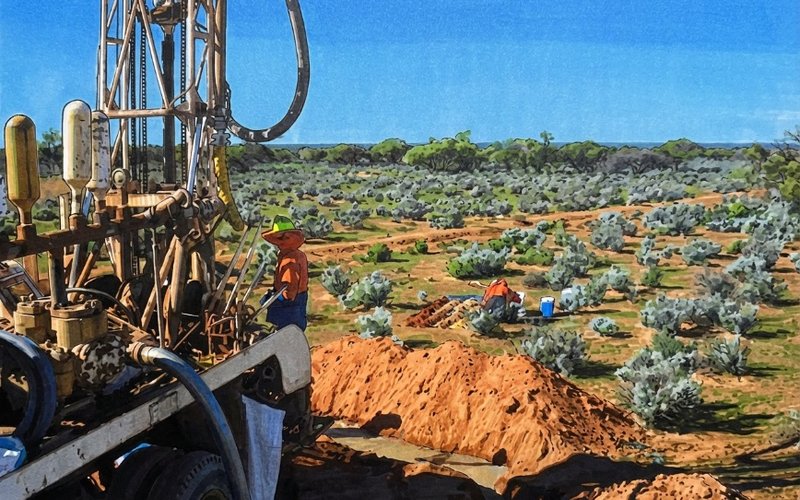
Alligator Energy (ASX: AGE) has delivered strong early operating results from the first well pattern at the Samphire uranium project field recovery trial, with uranium-rich solution produced at expected concentrations.
Recoveries and reagent consumption also tracked in line with modelled assumptions.
The trial has now progressed to approximately 39 of the planned 70 pore volumes (PV), with 1 PV representing the amount of solution needed to fill the natural void spaces within the contained orebody in the well pattern once.
Results to date have reinforced the company’s confidence in wellfield design, permeability, porosity, and solution flow performance.
Recovery Performance Builds
Pregnant lixiviant grades from the wellfield peaked at more than 200 milligrams per litre uranium oxide (U₃O₈) and remain above 100mg/L U₃O₈ based on assays from the onsite laboratory.
Uranium recovery has exceeded about 55% from the 39 PV processed so far, pointing to steady leaching performance and continued mobilisation of uranium within the wellfield.
Reagent consumption needed to achieve those recoveries has remained in line with expectations, which Alligator said reflects efficient leaching conditions and favourable operating parameters.
Those results have also supported confidence in the permeability and connectivity of the wellfield and in the project’s ability to meet the targeted uranium tenor and recovery assumptions set out in the scoping study.
Trial Nearing Final Stage
The field recovery trial began uranium extraction in late March and is continuing toward the planned 70 PV, with Alligator expecting to report final results from this well pattern at the end of April.
Chief executive officer Andrea Marsland-Smith said the outcome so far strongly validated the wellfield design and operating assumptions in the scoping study and demonstrated the effectiveness of the in-situ recovery process under field conditions.
“Importantly, we are seeing consistent solution flow and wellfield performance, which gives us confidence as we progress towards the planned 70 PV and continue to optimise recovery,” Ms Marsland-Smith said.
Assays from the onsite laboratory are now being validated through duplicate testing at a National Association of Testing Authorities certified external laboratory, with more detailed results due in due course.
