
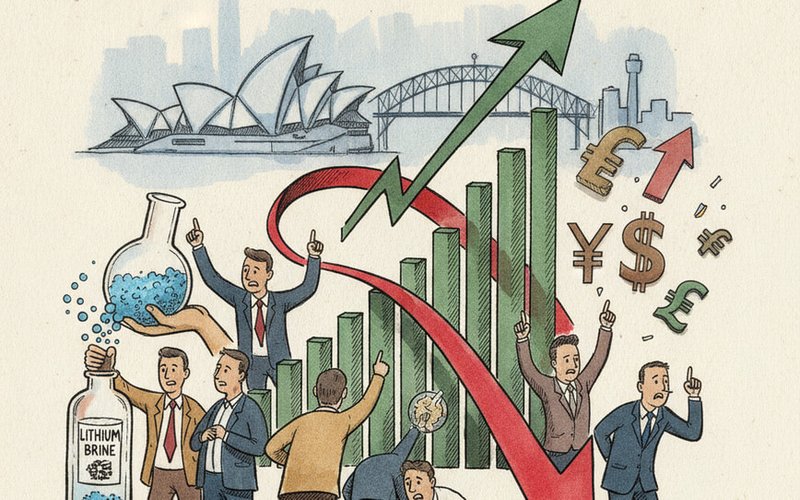

- 01ASX200: 8.7k-9k; narrow leadership.
- 02USD up; Fed hawkish; AUD/gold pressured.
- 03CPI 4.0%; core 3.6%; jobs +40k.
- 04JDO crash; heavy decliners; VIX ~11.7.
The ASX 200 arrived to Fridays close at 8,764 after 5 choppy sessions of volatility. The index remained boxed between support around $8,700 and resistance at $9,000, with leadership rotating sharply from day to day and market breadth negative throughout the week a sign that selective enthusiasm, rather than broad conviction, drove the market. The dominant macro story was a firmer US dollar and a hawkish Federal Reserve, which pressured the Australian dollar, gold and risk assets. It didn’t help that the domestic core inflationary print came in slightly higher than expected, pushing markets into a state of indecisiveness.
Australian Markets
It was a week of narrow leadership and persistent negative breadth, with decliners outnumbering advancers in every session. Despite the churn, implied volatility kept falling the ASX 200 VIX drifted from 12.44 down to a historically low 11.72, suggesting little near-term stress is being priced despite the macro backdrop.
The sector story changed almost daily. Technology had a standout Wednesday Wisetech (WTC) +14.1% to $32.81 and Xero (XRO) +8.9% to $70.77 as investors looked through offshore tech weakness, but the gains faded as the week wore on. Healthcare was a steadier contributor early, led by Telix (TLX), while Thursday saw cyclicals shine on stock-specific catalysts Lend Lease (LLC) +9.3%, Guzman y Gomez (GYG) +9.1% and Reece (REH) +8.4%. By Friday, gold miners carried the index: Perseus (PRU) +3.8%, Ramelius (RMS) +3.5% and Regis (RRL) +3.5%.
The pain was concentrated in resources, lithium, biotech and parts of financials. The most dramatic move of the week was Judo Capital (JDO), which collapsed 38.8% to 52 week lows on Thursday, underscoring sensitivity to funding costs among smaller lenders. Other heavy fallers included Iluka (ILU) 10.7%, Worley (WOR) 9.6%, IperionX (IPX) 9.8%, Mesoblast (MSB) 9.1%, Pilbara Minerals (PLS) 6.4%, Liontown (LTR) 5.5%, Technology One (TNE) 7.1% and Beach Energy (BPT) 8.2% (a five year low).
The domestic data flow was the week's bright spot. The key release May inflation came in softer than feared at the headline, with annual CPI easing to 4.0% (from 4.2%, versus 4.4% expected) and prices falling 0.7% month on month, the first monthly decline since August 2025. However, core inflation stayed sticky, with the trimmed mean lifting to 3.6% above expectations and the highest since September 2024. Labour and consumption data reinforced underlying resilience: the economy added 40,300 jobs in May (unemployment down to 4.4%), household spending rebounded +1.3% month on month, and the June manufacturing PMI held in expansion at 51.2. The 10 year government bond yield slipped to around 4.7%, a four month low.
International Markets
Offshore leads were largely unhelpful and set a cautious tone all week. The defining feature was a bifurcation within US technology: the semiconductor complex rallied hard on strong earnings Micron surged 16% after a blowout result and upbeat guidance, with Qualcomm +13%, Sandisk +22%, Applied Materials +13.4% and Western Digital +4.9% following while the consumer facing megacaps came under sustained pressure. Over the week, names such as Alphabet, Microsoft, Amazon, Meta, Apple and Nvidia all fell as investors questioned whether the scale of AI infrastructure spending will deliver adequate returns. The Nasdaq logged several consecutive down days, finishing the week soft - Alphabet did secure a place in the Dow Jones Industrial Average.
China was a clear drag, particularly into Friday, when the Shanghai Composite fell 2.26% to a two week low and the Shenzhen Component dropped 3.44%; both lost ~1.55% on the week. The selling again centred on technology as AI optimism curdled into caution. Adding to the mood were renewed China & Japan trade frictions (tungsten and rare earth restrictions) and decelerating local government fiscal spending. Given China's role as Australia's largest trading partner, this remains a key watch item for the Materials and Resources sectors.
The cleanest expression of the macro backdrop was in currencies. The Australian dollar fell below US$0.690 to a three month low, with the greenback firm on expectations of further Fed tightening. By week's end, markets were pricing roughly a 75% chance of a September Fed hike, while expectations for further RBA tightening eased markets assign only about a 50% probability of another increase to the 4.35% cash rate, and some participants have begun pricing RBA cuts into the second half of 2027. That widening policy divergence is a straightforward headwind for the Aussie dollar.
Commodities
Commodities were broadly weak, and that weakness was the principal source of pressure on the resource heavy ASX.
Gold had a tough week, sliding from above US$4,100 to around US$4,000/oz a weekly loss of roughly 5% and an eight month low at one point. The driver was the hawkish Fed: higher for longer US rates and a stronger dollar are fundamentally hostile to a non yielding asset. Notably, Friday's bounce in the gold miners came despite the metal's pullback, a reminder of how stock specific positioning can diverge from the underlying commodity.
Crude oil extended its decline below US$71/barrel, a third consecutive weekly fall, unwinding most of the earlier geopolitical risk premium. Markets are placing growing credibility on the US Iran peace process supported by a temporary US waiver on Iranian crude, improved tanker flows through the Strait of Hormuz, and recovering Middle East exports. A vessel incident off Oman late in the week reignited some security concerns, but flows through Hormuz nonetheless reached their fastest pace since the conflict began.
Lower commodity prices cut both ways for Australia: they weigh on energy and resource earnings, but easing fuel costs also help moderate inflation feeding back into the RBA's policy calculus.
Stocks in Focus: The Structural Metals Cycle
A multi year re rating is building across ASX materials, as structural industry demand for AI data centres, electrification and grid buildout, meets years of supply underinvestment. The sector remains structurally under owned (the top five global miners are ~0.4% of the MSCI ACWI, versus ~16.8% for the top five tech names), which is precisely where the opportunity lies. Five operating names with real cash flows and near term catalysts stand out:
Sandfire Resources (SFR): Pure play copper producer (MATSA in Spain, Motheo in Botswana) targeting 149 to 165kt CuEq for FY26 and now net cash (US$76m) after a 20% H1 EPS beat. Trading ~$19.35 to 20.02 (+79% on the year); near-term catalysts are the Motheo A1 maiden reserve, a 23 July production update and 26 August earnings.
Capstone Copper (CSC): Diversified Americas copper (Arizona, Mexico, Chile) with six straight quarters of record adjusted EBITDA (US$329m in Q1). A higher beta complement to SFR at ~$13.92 (+64% on the year); 30 July earnings is the next test of whether the EBITDA streak extends to a seventh quarter.
South32 (S32): Diversified base-metals compounder (~90% base metals across Sierra Gorda copper, Cannington zinc silver, plus alumina and manganese). The re rating hinges on Hermosa in Arizona, a dual zinc/manganese critical minerals asset, with a Final Record of Decision expected July 2026; consensus fair value sits around $4.67 to 4.72.
Lynas Rare Earths (LYC): The largest rare earths producer outside China and increasingly priced as strategic infrastructure, with H1 FY26 revenue up 63% to $413.7m and margins expanding to 19% on stronger NdPr pricing. Around $17.77 (consensus ~$19.70); the 23 July June quarter update is the key near term catalyst.
Pilbara Minerals (PLS): A record March quarter output (232.4kt), FOB costs down to $520/t, a $1.455b cash buffer and a US$1,000/t SC6 floor price locked in via the Canmax offtake. Notably one of Friday's hardest hit (6.4% to $5.03, well off its 3 June high of $6.81), with the earlyJuly Ngungaju restart (~200kt) the next catalyst into H2.
Broader Outlook
Aussie markets will enter the second half of 2026 caught between resilient domestic fundamentals and a challenging global backdrop. Softer headline inflation, a strong labour market, rebounding household spending and falling bond yields all point to a domestic economy that is holding up. Against that, sticky core inflation, a weak currency, a hawkish Fed, falling commodity prices and a soft China continue to warrant caution.
With volatility subdued and breadth weak, the market looks to be in a consolidation phase rather than at a decisive turning point. Leadership is increasingly selective gold and quality growth are finding bids while lithium, biotech and rate sensitive financials struggle which keeps sector selection and thematic discipline front and centre.
The key watch items into the coming weeks are: the direction of the US dollar and the Fed's rate path; whether Australian core inflation begins to moderate more convincingly (and how the RBA frames its next move); developments in the US Iran negotiations and their flow through to oil; and Chinese demand signals for the resources complex. Until there is greater clarity, the index is likely to keep trading the $8,700 to $9,000 range, rewarding stock-specific stories over broad market beta.
Get the wire before the market opens.
The ASX small-cap stories that matter, filed before 9am AEST. Curated by the Small Caps desk.