

- 01NPV $858m, post-tax IRR 99%, payback 0.9y.
- 02Maiden reserve 26 Mt @ 920 ppm TREO; total MREO 243 Mt @ 751 ppm.
- 03Capex $178m for 3 Mtpa; heap leach, shallow pit.
Australian Rare Earths (ASX: AR3) has completed a pre-feasibility study (PFS) and maiden ore reserve for its 100%-owned Koppamurra rare earths project in South Australia, confirming a low-capital development case with strong forecast returns.
The study returned a base case post-tax net present value (NPV) at an 8% discount rate of $858 million, a post-tax internal rate of return (IRR) of 99% and a post-tax payback period of 0.9 years from first production.
Koppamurra is modelled as a 12-year operation producing an average 1,860 tonnes per annum of total rare earth oxides (TREO) within a mixed rare earth oxide (MREO) feedstock product.
The PFS is underpinned by a maiden probable ore reserve of 26 million tonnes at 920 parts per million TREO, with the broader project holding a total mineral resource estimate of 243Mt at 751ppm TREO.
Low-Capital Development Case
Australian Rare Earths estimates initial capital expenditure of $178m for a 3Mtpa processing operation based on shallow open-pit mining, heap leach processing, and offsite calcination.
The cost profile includes operating costs of US$34.14 per kilogram TREO, excluding royalties and all-in sustaining costs of US$38.32/kg TREO.
Annual base case revenue is forecast at $290m, with annual EBITDA of $184m and annual operating cash flow of $139m.
The project economics remain robust when modelled only on ore reserves and excluding inferred resources, with that case still generating a post-tax NPV of $652m.
Ionic Clay Advantage
Located about 30km south-east of Naracoorte on South Australia’s Limestone Coast, Koppamurra hosts shallow clay-hosted rare earth mineralisation within the Murray Basin.
The deposit is suited to free-dig open-pit mining, with rare earth mineralisation typically sitting within two to three metres above weathered limestone basement and requiring minimal overburden movement.
Australian Rare Earths expects the simple mining method to avoid drilling, blasting, and hard rock crushing, reducing capital intensity and supporting progressive rehabilitation.
The project’s heap leach flowsheet uses diluted sulphuric acid and magnesium sulphate solution to extract rare earth elements before precipitation and offsite calcination into a final MREO product.
Strategic Product Mix
The Koppamurra product is expected to contain a magnet rare earth element component accounting for approximately 25% of TREO.
Average annual production is forecast to include 435t of neodymium-praseodymium, 57t of dysprosium and terbium, 238t of yttrium, 69t of samarium, 67t of gadolinium, and 4t of lutetium.
Australian Rare Earths considers the basket strategically valuable because several of those elements are exposed to constrained Western supply chains and Chinese export controls.
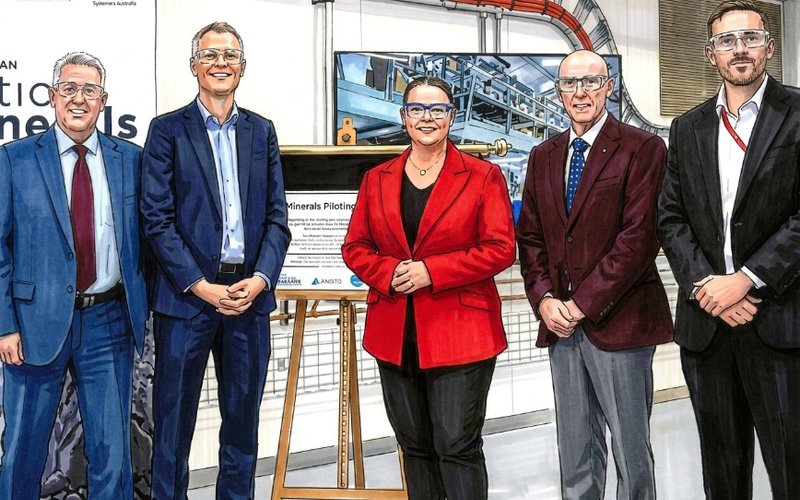
The company expects offtake discussions to accelerate as pilot-scale operations at ANSTO’s new critical minerals processing facility in Sydney generate product samples for potential customers.
Study Supports Next Phase
The development case draws on more than 65,000m of drilling across 6,042 holes, a completed bulk sample pit, and extensive metallurgical test work completed with groups including ANSTO, CSIRO, Bureau Veritas, and the University of Toronto.
The life-of-mine production target is supported by approximately 71% probable ore reserves and 29% inferred mineral resources, with Australian Rare Earths noting the inferred component carries lower geological confidence.
A broader exploration target of between 680Mt at 820ppm TREO and 3,620Mt at 540ppm TREO provides potential to extend the mine life beyond the initial PFS case.
The company is targeting submission of a mining lease application in 2026, while environmental work across groundwater, surface water, soils, vegetation, heritage, air quality, rehabilitation and community engagement continues.
Clear Development Pathway
Managing director and chief executive officer Travis Beinke said the PFS results were the “hallmark of a project designed with simplicity in mind”.
“The PFS reflects years of careful, methodical work across drilling, environmental studies, metallurgical test work and engineering—we have been deliberate and strategic at every step, designing the project and positioning the business for long-term success,” he said.
“Beyond the numbers, the Koppamurra MREO basket assemblage could not be more relevant or strategically critical to Western customers today.”
“The path ahead is clear: Detailed Feasibility Study initiation, Mining Lease submission, product qualification, adding more tonnes through the drill bit and advancing offtake and funding discussions,” he said.
Get the wire before the market opens.
The ASX small-cap stories that matter, filed before 9am AEST. Curated by the Small Caps desk.