
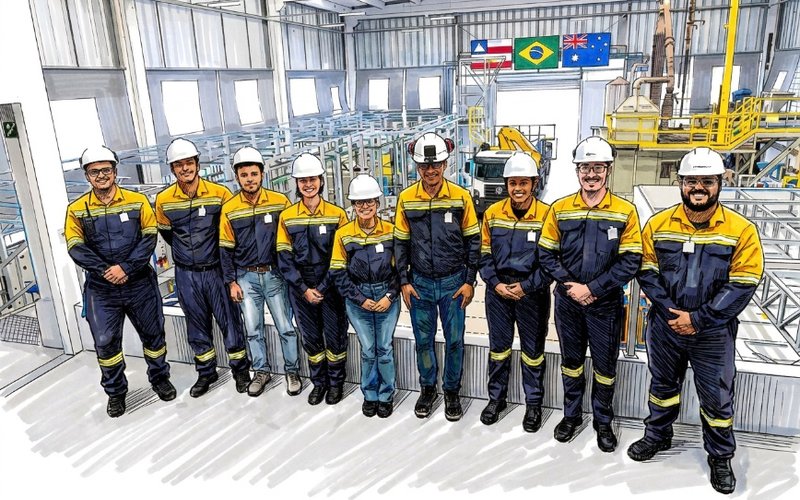

- 01Stage I: first RE concentrate.
- 02Stage II: co-fund R$6.4m; 59% capex/opex; 4Q26 on-site; 2Q27.
- 03Carester leads separation; 10-year HRE+ off-take; Monte Alto.
Brazilian Rare Earths (ASX: BRE) has commissioned its Stage I metallurgical pilot plant at Camaçari in Bahia, producing its first rare earth mineral concentrate and moving its pre-feasibility study into bulk-scale metallurgical test work.
The company has also secured R$6.4 million, equivalent to about A$1.7m, in co-funding from SENAI CIMATEC and partner organisations for the Stage II hydrometallurgical pilot plant, covering about 59% of expected capital and operating costs.
Stage II equipment is expected on-site in 4Q26 ahead of planned commissioning in the second quarter of 2027, extending the program from beneficiation through hydrometallurgical extraction and separation.
Work during this phase will also assess potential recovery pathways for uranium, scandium, niobium, titanium, and tantalum from process solutions and residues generated during piloting.
Together, the two stages are intended to generate operating and product-quality data for process design, equipment selection, cost estimates and customer qualification while testing additional value from the Monte Alto feedstock.
Stage I Bulk Testing
Stage I uses physical beneficiation to concentrate rare earth minerals from ore, with configurable circuits allowing the company to test feedstocks from across the Rocha da Rocha Province and optimise processing performance.
Systematic campaigns will now focus on concentrate grade and recovery while generating material for downstream testing and refining the processing flowsheet and engineering assumptions used in the PFS.
The results will also support assessment of a potential fast-track development pathway for exports of upgraded Monte Alto mineral concentrate, although this option remains subject to further engineering and technical studies.
Product samples from the integrated program are intended to support customer test work, qualification and offtake discussions as the company builds the technical data required for its refinery plans.
Stage II Processing Chain
The second stage will add hydrometallurgical extraction and separation to establish an integrated ore-to-oxide pilot capability at Camaçari and test production of neodymium-praseodymium (NdPr) oxide, heavy rare earth (HRE+) concentrate and uranium yellowcake.
SENAI CIMATEC will continue supporting the development program while French rare earth separation specialist Carester will lead the separation workstream and contribute to engineering, design and commissioning for the planned Camaçari refinery.
Carester is also Brazilian Rare Earths’ HRE+ concentrate offtake partner under a binding initial 10-year sales agreement covering product containing up to 150 tonnes per annum of dysprosium and terbium.
“The Scoping Study includes the cost of recovering uranium but no uranium revenue, and the potential to include scandium and other strategic co-product revenues provides further potential upside—successful commercialisation could create additional cost credits and deepen our cost advantage on the global cost curve,” chief executive officer Bernardo da Veiga said.
“With SENAI CIMATEC’s continued co-funding and Carester’s rare earth separation expertise, we are enhancing the technical data to advance our integrated rare earth hub-and-spoke processing platform in Brazil.”
Get the wire before the market opens.
The ASX small-cap stories that matter, filed before 9am AEST. Curated by the Small Caps desk.