
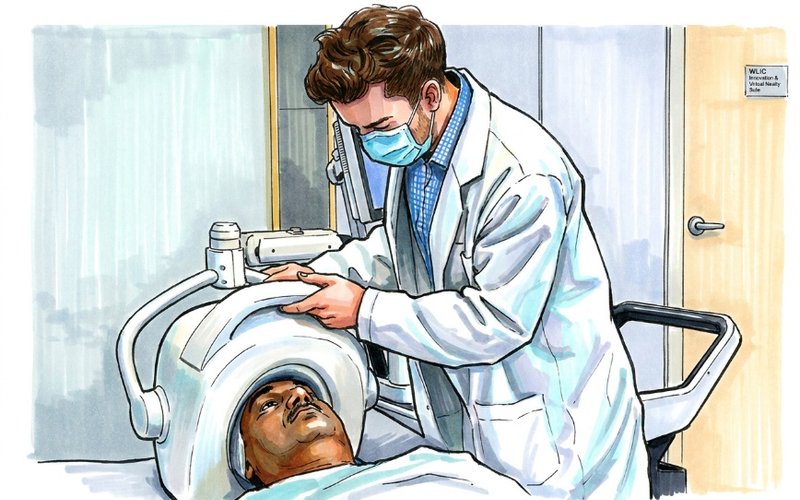

- 01EMV's emu validation trial hits enrolment milestones.
- 02US sites on board: Mayo, Mt Sinai, UCLA, Memorial Hermann.
- 03Ischaemia endpoint added; boosts differentiation.
EMVision Medical Devices (ASX: EMV) has reported strong progress during the June quarter on a pivotal validation trial for its emu bedside brain scanner, with recruitment now past key enrolment milestones across the training and primary analysis cohorts.
The multi-centre, prospective, blinded diagnostic trial is designed to support US Food and Drug Administration De Novo clearance for the first-generation commercial device, with the primary objective of demonstrating haemorrhage detection sensitivity and specificity of greater than 80%.
Recruitment momentum continues to build across active US and Australian hospitals, supported by acceleration initiatives introduced during the quarter.
Queensland’s Princess Alexandra Hospital — a participating site in EMVision’s continuous innovation study — is transitioning to the trial, leveraging existing site readiness, trained staff, and clinical familiarity with the technology.
US hospitals including Mayo Clinic, Mt Sinai, Ronald Reagan UCLA Medical Centre, and Memorial Hermann-Texas Medical Centre are also onboard, reflecting growing clinical interest in the trial and technology.
Additional Detection Endpoint
EMVision is preparing to add an acute ischaemia detection endpoint to the validation trial following significant progress on the feature’s development in the continuous innovation study.
As ischaemic stroke patients have already been enrolled to the trial, the modifications are expected to be incremental and may include minor adjustments to the required sample to ensure the ischaemic sub-cohort meets statistical objectives.
Validation of an ischaemia detection feature is expected to significantly strengthen emu’s clinical and commercial value proposition and differentiate EMVision from other point-of-care technologies.
“Because stroke interventions are highly time-dependent, the ability to rapidly detect and classify both stroke types in one scan has the potential to reduce intervention delays and improve patient outcomes,” the company said.
“Generating ischaemia performance data on emu also builds the clinical and regulatory foundation for our second generation First Responder portable device in pre-hospital settings.”
Continuous Innovation Study
EMVision continued to advance its continuous innovation study during the quarter to support AI model refinement and feature development through a generation of proprietary datasets from suspected stroke and traumatic brain injury (TBI) patients.
The data is expected to strengthen its competitive positioning and facilitate ongoing platform development in features including acute ischaemia and large vessel occlusion (LVO) detection.
The study’s clinical footprint continues to evolve, with Box Hill Hospital replacing Princess Alexandra Hospital as it transitions to the validation trial.
Additional site activations are underway to enable efficient clinical data generation.
Regional Benefit Study
EMVision has been preparing a regional benefit study in partnership with the Australian Stroke Alliance (ASA), Titan Pre-Hospital Innovation, and SA's Rural Support Service, for launch before year end.
The study targets regional locations underserved by current stroke diagnostic practices, where patients may travel for hours before a diagnosis is made and treatment can begin, and is believed to present a major opportunity for the company to expedite patient management and improve outcomes for remote Australians suffering stroke.
EmVision’s air deployment study — conducted in partnership with the Royal Flying Doctor Service, ASA and SA Ambulance Service — concluded enrolment during the quarter.
The study aims to demonstrate First Responder’s compatibility across varied real-world operational environments including in clinics, on-board aircraft, on tarmacs, in hangars and on remote runways.
Flight compatibility has been confirmed across 14 aeromedical transfers spanning 12 airstrips located up to 371 kilometres from Adelaide airport, with scans concluded rapidly and well-tolerated by patients.
First Responder Development
EMVision’s First Responder program advanced during the period, with multiple pre-hospital feasibility and usability studies completed or nearing completion.
The device is a miniaturised portable evolution of the emu scanner designed for use in pre-hospital settings to support earlier assessment, triage, transfer, and treatment decisions for patients at the scene of suspected stroke and traumatic brain injuries (TBI).
“The tyranny of distance has long shaped stroke outcomes—rural and remote patients wait longer for the definitive neuroimaging that determines treatment and are far less likely to receive time-critical interventions such as thrombolysis or endovascular thrombectomy for ischaemic stroke, or urgent blood pressure management and neurosurgical intervention for intracerebral haemorrhage, within the treatment window,” the company said.
“These results provide real-world evidence that First Responder can be operated effectively in the demanding aeromedical environment, directly addressing this gap and validating an important target use case and future commercial opportunity for the device.”
Mobile Stroke Unit Study
Stage 1 of EMVision's mobile stroke unit (MSU) study is expected to complete recruitment and reporting this quarter, adding a further important dataset to First Responder’s growing body of pre-hospital evidence.
Conducted in partnership with Ambulance Victoria, Royal Melbourne Hospital, and ASA, the study represents a strategically significant opportunity for the company, with First Responder being evaluated within one of the few MSUs in the world that is involved in conducting clinical research at the forefront of hyperacute stroke care.
Stage 1 is expected to provide valuable real-world feedback on workflow integration to support expanded research onboard the MSU and usability during in-field pre-hospital patient encounters where First Responder is designed to deliver meaningful clinical value.
Preparations also advanced during the quarter for an upcoming study to evaluate the production-equivalent First Responder device in road ambulance operations, extending pre-hospital testing beyond aeromedical and MSU settings to the highest volume emergency response environment.
A usability workshop provided operator feedback on device set-up and scanning within the constraints of a road ambulance, which will be used to inform study design.
Industry Conference Participation
EMVision participated in the medical technology enterprise consortium, which partners with the US Department of Defence to accelerate the development and deployment of medical solutions for service members.
Representatives engaged directly with the military health community, where TBI represents a significant clinical priority and where care is frequently delivered in field and pre-hospital environments which lack access to conventional neuroimaging.
The company also delivered a presentation to delegates at the international conference on emergency medicine in Germany, explaining the role of EMVision’s portable brain scanners in closing the diagnostic gap in stroke and TBI.
At end June, EMVision had cash reserves of $17.1 million and access to non-dilutive funding of $4.6m from existing grant programs.
The company enters the second half of the year with multiple clinical studies in progress, a pivotal trial which is building momentum and a balance sheet capable of supporting continued execution across both emu and First Responder programs.
Get the wire before the market opens.
The ASX small-cap stories that matter, filed before 9am AEST. Curated by the Small Caps desk.