

- 01Maiden RC at Union Jack hits sulphides.
- 023m, 9m, 13m sulphide zones; pyrite to 35%.
- 03Assays due in ~2 months; plan follow-up EM.
Iltani Resources (ASX: ILT) has intercepted lead-zinc-copper sulphides in maiden drilling at the Union Jack prospect within the Featherbed Volcanics zone of its Herberton project in north Queensland.
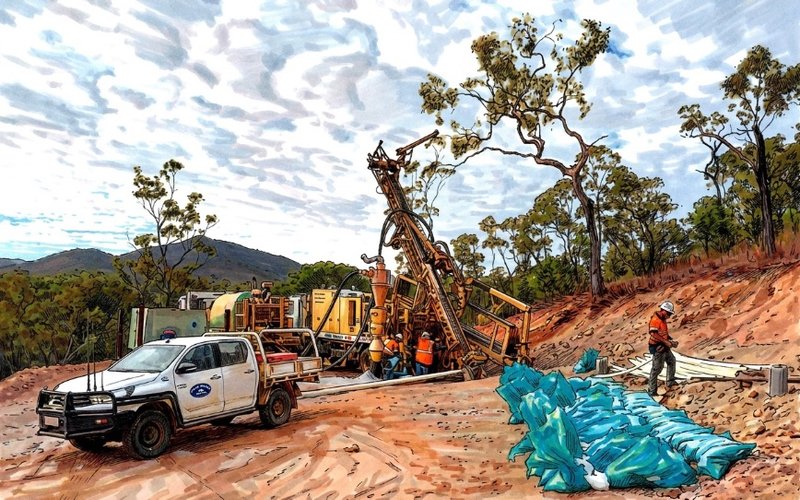
The company completed three reverse circulation holes for 666 metres to test anomalies around the Union Jack historical workings generated by a Herberton versatile time domain electromagnetic (VTEM) survey in 2025.
The first hole tested below the workings and intersected 3m of sulphides plus potentially related pyrite mineralisation of up to 15% sulphides from 113m to 116m, while the second hole tested intercepted 9m of sulphides plus pyrite of up to 35% sulphides from 165m to 174m.
The third hole intersected 13m of sulphides plus pyrite of up to 25% sulphides from 6m to 19m and a second VTEM plate of opposite dip and lesser magnitude was interpreted at the same location for future drill testing.
Prior Union Jack Exploration
Iltani first sampled small-scale historical workings at Union Jack in 2023, returning up to 2.3% copper, 39.5 grams per tonne silver, 0.25g/t gold, and 25g/t indium.
These workings had received minimal previous exploration until that point, and had never been previously drill tested.
The Herberton VTEM generated two anomaly plates north and south of the workings, based on greater resolution, size, and depth.
Iltani drilled three holes to test these plates as part of the Herberton regional exploration program, and is planning more detailed mapping and sampling at Union Jack to confirm any surface indications of mineralisation associated with the historical workings and shallow intersections.
Large-Scale Mineralising System
lltani managing director Donald Garner believes there is the potential for a large-scale mineralising system to be present at Union Jack.
“Our drilling was a great success, intercepting sulphide mineralisation in all holes, [and] it was particularly pleasing to see that [the second hole] intersected a strong zone of sulphide mineralisation exactly where the geophysical modelling of the VTEM plate predicted, which confirms the ability of our airborne survey to locate unknown sulphide mineralisation,” he said.
“The team has lined two drill holes that tested the VTEM targets with polypipe in preparation for a follow-up downhole electromagnetic survey.”
Samples from the drilling program have been processed and submitted to the Intertek lab in Townsville for assay, with results expected sometime in the next two months.
“Once we have the assay results back, we will plan our next steps—we will be back at Union Jack sooner rather than later,” Mr Garner added.
Get the wire before the market opens.
The ASX small-cap stories that matter, filed before 9am AEST. Curated by the Small Caps desk.