

- 01Mic-free keyword spotting under 1mW on ECS-DoT.
- 02Bone-vibration wake words; no microphone.
- 03Ambient noise excluded at source; privacy preserved.
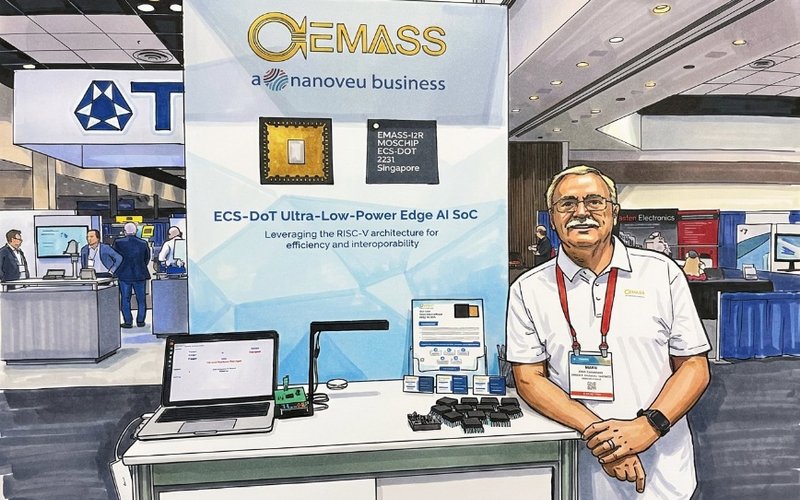
Nanoveu (ASX: NVU) subsidiary Embedded AI Systems (EMASS) has demonstrated microphone-free keyword spotting at under 1 milliwatt on the ECS-DoT chipset for extreme power efficiency and ultra-low latency AI applications.
The novel sensing wearable device architecture achieved real-time keyword spotting from jawbone vibration, capturing speech through the body rather than the air at a sub-milliwatt power envelope that allows the system to remain “always on” without materially impacting battery life.
The EMASS trial was able to simultaneously deliver noise immunity, low power, and real-time response.
Traditional architectures often have to weigh two of the three.
Ambient Noise Capture
Ambient noise is excluded at the source without the need for noise-cancellation processing, while also inherently protecting user privacy as nearby conversations cannot be inadvertently captured.
Such technology is primarily found in premium earbuds and communication headsets, where it works to improve voice isolation and call clarity.
However EMASS is pioneering the use of this sensing modality to detect voice commands and wake words directly from bone vibration at the sensor level, without waking the host processor.
Rather than using motion to wake an audio subsystem, ECS-DoT can now perform keyword spotting directly on the vibration signal, removing the microphone from the detection path, advancing a bone-conduction hearables reference design announced by EMASS in March.
Nanoveu said microphone-free technology would surpass existing approaches to wearable voice activation which feature responsive “always on” microphones capable of capturing all noises but consuming more power in louder environments, as well as motion-triggered, duty-cycled wake systems that save power but add lag.
Common Power Constraints
Nanoveu chief executive officer of semiconductor technologies Mark Goranson said the demonstration addressed common power consumption and ambient noise constraints of wearable voice interface design.
“Recognising speech directly from bone-conduction vibration at under one milliwatt, with no microphone in the signal path, shows ECS-DoT can extract a meaningful signal from mechanical vibration in real-time within a power budget that compact, battery-powered devices can support,” he said.
“We see that core capability as applicable well beyond hearables to other products that need to interpret vibration on tight power and thermal budgets and that is central to how we are positioning ECS-DoT.”
The hearables market is forecast to grow from US$62 billion in 2026 to US$107b by 2031, with voice emerging as the primary control interface for next-gen devices.
Get the wire before the market opens.
The ASX small-cap stories that matter, filed before 9am AEST. Curated by the Small Caps desk.