
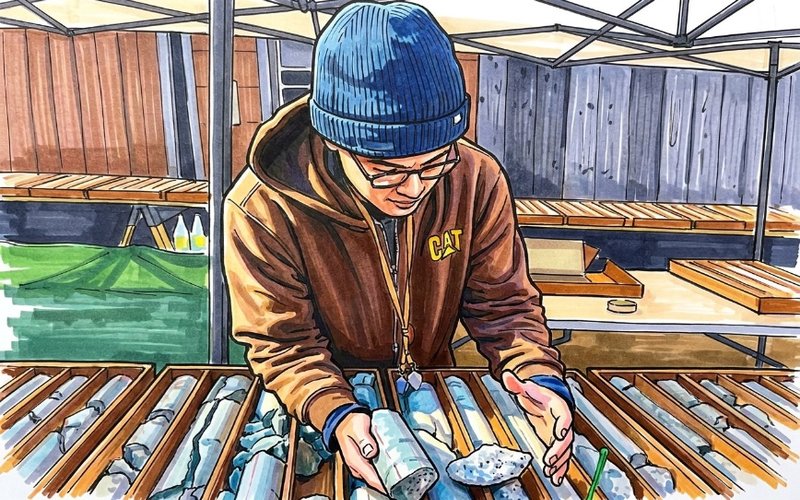
Resolution Minerals (ASX: RML) has completed three holes for 763 metres as part of a drilling campaign targeting tungsten-gold mineralisation south of the Golden Gate South prospect within its Horse Heaven project in the US.
The company observed “highly encouraging” sulphide mineralisation (pyrite, arsenopyrite) associated with intense alteration of a granite—together with interpreted large-scale shearing and brecciation and areas of intense veining—across all holes, and reported that the same features are present in well-mineralised holes at Golden Gate North.
The three holes form part of the 2026 Golden Gate diamond drilling program comprising 45 holes for up to 13,700m and supported by two MP1500 rigs at Golden Gate South and Golden Gate North.
Drilling will test extensions of a 500m x 600m coincident gold-tungsten soil anomaly and areas targeted by historical tungsten mining.
Style of Mineralisation
Technical lead geologist Bill Breen said the company was excited by the style and extent of mineralisation and alteration observed in the first core.
“This is simply because this style of mineralisation elsewhere at Golden Gate is associated with significant gold and tungsten mineralisation,” he said.
“The fact that these holes were drilled in a previously unexplored area, some 500m south of gold mineralisation identified in the southern-most holes of last year’s drilling program, only adds to the positive weight of these initial results.”
The company believes there is significant scalability combining the target areas, especially where the mineralisation is open-ended in all directions.
Golden Gate History
Tungsten exploration and development at Golden Gate began in the late 1940s, with open pit mining commencing in the early 1950s and ore initially processed at the Stibnite mine, mill and smelter until its closure in 1952.
The area was most recently mined in 1980, with composite samples from stockpiles held at the recently acquired Johnson Creek mill site returning assays of up to 1.85% tungsten trioxide.
Golden Gate, which sits adjacent to Perpetua Resources’ Stibnite gold-antimony development, forms part of Resolution’s broader Horse Heaven antimony-tungsten-gold-silver project.
To further fast-track the current program, a second drill rig has arrived on site and Resolution expects it to start turning early next week.
