


- 01Phosphate squeeze; sulphur bottlenecks.
- 02Mosaic trims US/Brazil output.
- 03Global phosphate deficit risk ~30mnt.
- 04Copper hits highs; gold lags.
Welcome back to The Weekly Finger.
If you have been paying attention to the machinery underneath the global economy, you will know that the narrative is shifting fast.
We are moving out of the purely speculative macro phase and straight into the physical realities of supply chains, weather disruptions, and critical metal deficits.
Here is what hit the desk this week, how it connects, and why you should care.
Starting with scary things:


London’s Hyde Park August 2025 to today….driest July on record recorded in Southern England.
1. The Fertiliser Check: Weather vs. Real-Economy Supply Chains
We start with the baseline of the physical economy: agriculture and core inputs.
Reiteration of how bad the fertiliser issue will get in the world since the Hormuz situation seen by the Mosaic (US listed fertiliser giant) earnings call last week.
Summary:
Phosphate Supply Squeeze & Production Curtailments
- Input Cost Pressures: Global flows of sulphur are heavily disrupted due to ongoing geopolitical bottlenecks (including the closure of the Strait of Hormuz and a blockade in Kazakhstan). Unusually high spot sulphur prices have squeezed margins across the industry.
- Idled Production: In response, Mosaic has curtailed phosphate output in the US and Brazil to limit exposure to expensive raw materials. Its Louisiana facility is fully idled, Bartow is running at roughly 40% capacity, and other Central Florida plants are operating in the mid-70% range.
- Global Deficit Threat: CEO Bruce Bodine estimates global phosphate production could fall short by up to 30 million tonnes if sulphur supply constraints persist.
Link here for those who want the full chat.
2. Copper Hits All-Time Highs and the Gold Lag
Speaking of physical realities, Copper hit new all-time highs last week.
Between massive grid overhauls, data centre buildouts, and ongoing structural mine deficits, copper is doing exactly what it’s meant to.
Note I interviewed Alma Metals (ASX: ALM) last week as they move into something very real.
This brings us to a crucial chart and thesis highlighted by Tavi Costa in his piece, The Tale of Two Metals (paywalled sorry). Costa points out one of the most compelling divergences in modern markets: copper leads the physical supply charge, while gold historically lags before playing violent catch-up.
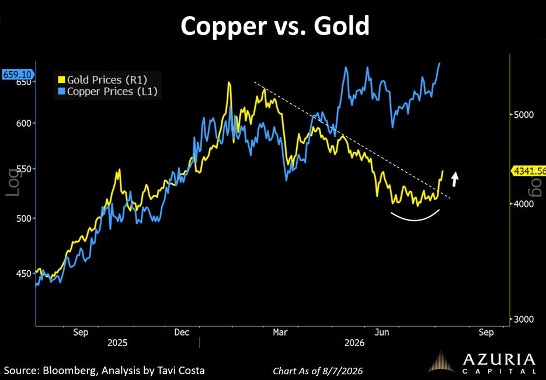
As Costa notes, "the lag is your friend."
When copper breaks out to record levels on industrial demand and supply tightness, it re-prices the entire commodity complex. Gold eventually catches up once currency debasement, government debt pressures, and monetary realities collide with the physical cost of metals.
Maybe taking some profits on your copper holdings and adding some cheeky gold plays here isn’t the worst idea.
3. Sovereign Money Steps Up: Watching the US EXIM Bank
While markets attempt to value these metals, governments are waking up to the fact that they cannot afford to leave supply chains solely to market clearing prices.
Case in point: the latest funding announcement from the US EXIM Bank on Twitter/X, pouring fresh capital directly into critical mineral projects ranging from graphite and rare earths to strategic metals.
Washington and Western export credit agencies are increasingly acting as senior lenders to secure ex-China supply chains.
The macro thesis is undeniable, but from an investment perspective, we remain in a "watch and wait" phase.
Big debt facilities and sovereign letters of intent make great headlines, but institutional capital is sitting back to see how quickly these dollars actually hit the dirt, secure real off-takes, and transform into active production.
4. Ground-Level Reality: Golden Globe Resources & Discovery
It is one thing for governments to pledge funds and for macro charts to point up; it is another thing to go out and actually find the ore.
On last week's episode of the Theory of Thing Investment Podcast, I sat down with Golden Globe Resources (ASX: GGR) chief executive officer Colin McMillan for a detailed update on their phase-one exploration progress.
They recently rediscovered the historic Burns Spur Copper Mine, pulling high-grade rock chips including 4.2% Cu and 0.5g/t Au. Between their upcoming work at the Alma project near Mount Morgan and proof-of-concept drilling at Neela Creek in the Lachlan Fold Belt, GGR is a prime example of the grassroots exploration required if the market has any hope of filling the massive copper and critical mineral deficits we keep talking about.
Make sure to listen to the full podcast episode on Acast to hear the complete breakdown on GGR, macro breakouts with Heath Moss, and broader market commentary.
The Takeaway
Whether it is fertiliser inputs constrained by weather, copper breaking record highs while gold prepares its lag trade, or sovereign capital backing junior explorers, the takeaway is identical: the physical economy is reasserting itself.
The Fun Stuff
Remember Covid when everyone played Wordle and it launched some impressive and addictive games to keep us busy while we sat at home pretending to pay attention to Zoom calls? I’ve found a new one. It’s called Wen-Ware- Explore, a 360° scene, guess and pinpoint when and where the moment happened. It’s painfully difficult but quite interesting for history fans like myself.
Good luck and stay safe,
James
Get the wire before the market opens.
The ASX small-cap stories that matter, filed before 9am AEST. Curated by the Small Caps desk.